
Orchideus — a workflow orchestrator for microservice systems
A unified control plane for workflow execution: reliable orchestration, retries, error handling, and full diagnostics — without complicating application services. Orchideus is built on Conductor (Netflix Conductor).
- Enterprise-ready orchestration platform
- Execution observability and control
- Integrations for your existing stack
From workflow definition to controlled execution in distributed systems.
About the product
Orchideus is a platform for microservice orchestration and business process automation.
Orchideus is built on Netflix Conductor: we extend and harden Conductor for enterprise orchestration, and add a polished UI, observability, and integrations.
Orchideus moves orchestration logic out of application services into a unified execution and observability layer.
Orchideus is built around three core stages of working with processes.
Declarative workflow definitions: steps, conditions, parallelism, retries, and timeouts are described as data rather than embedded into service code.
Controlled process execution with configurable retry policies, error handling, and support for long-running operations in distributed environments.
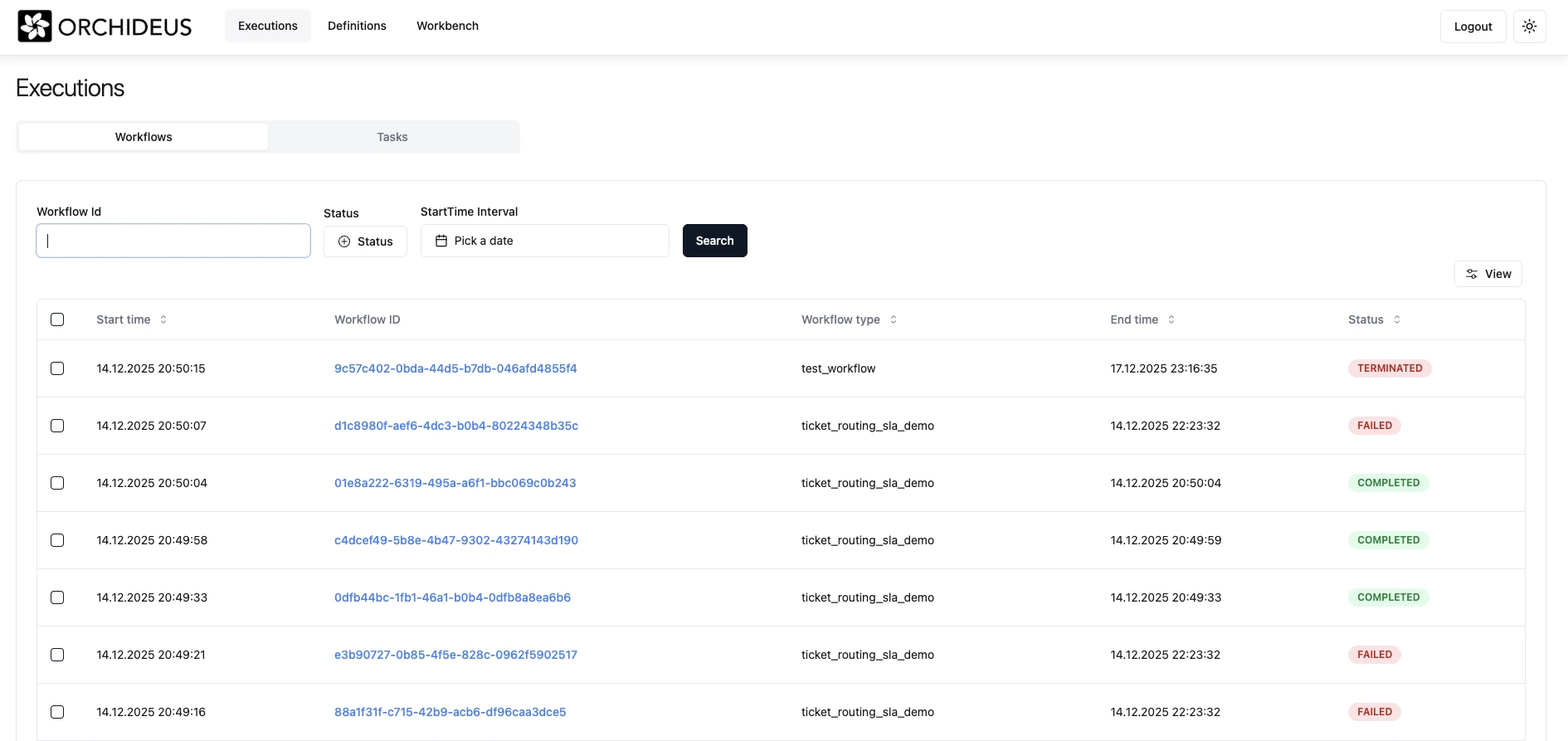
Centralized execution history, step-level statuses, diagnostics, and controlled process restarts from a single interface.
Who it's for
Orchideus is designed for teams and systems where process orchestration becomes a critical engineering concern.
Problems Orchideus solves
In distributed systems, process execution quickly becomes a source of complexity and operational risk.
Use cases
Common business scenarios where orchestration has the highest ROI: reliability, controlled execution, and fast recovery when things go wrong.
Long dependency chains with retries/timeouts and full execution history in one place.
Sagas, rollbacks, and guaranteed completion even when some integrations fail.
Multiple data sources, async steps, and SLAs managed as a single workflow.
Low idle cost, controlled retries, and transparent diagnostics per decision.
Long-running end-to-end processes with external dependencies and recovery requirements.
Stitch steps across old and new systems without a big-bang rewrite and without losing observability.
Architecture
Orchideus integrates with queues, persistence layers, and indexing backends that match your technology stack — without vendor lock-in.
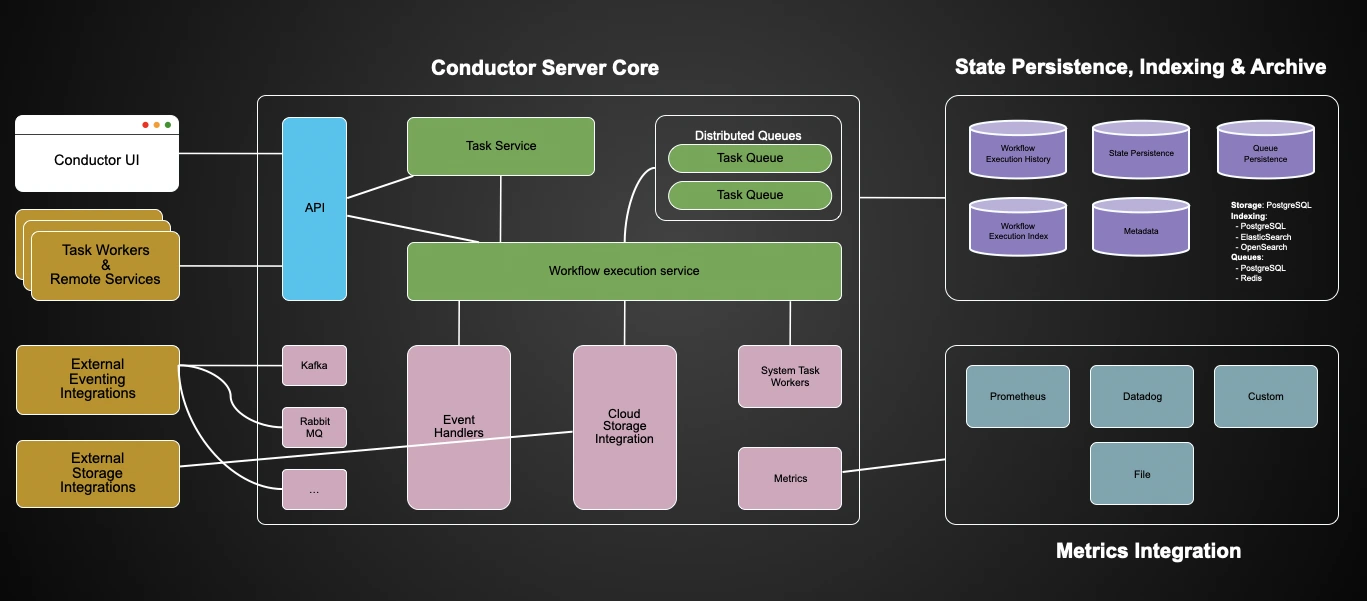
Stateless server schedules steps via task queues, workers execute them and report status.
- Task queues per type
- Event-driven architecture
- Horizontal worker scaling
Modular architecture: storage and search layers connect as plugins.
- Backend selection for your infrastructure
- Independent component scaling
- No vendor lock-in
Centralized execution data collection for monitoring and debugging.
- Execution history in index
- Queue and worker metrics
- Monitoring system integrations
Enablement & rollout
We don’t just ship software — we make your team autonomous. We help you align on modeling practices, set up the environment, and start running workflows safely in production.
Hands-on sessions on your real cases: modeling workflows, configuring retries/timeouts, and diagnosing failures.
We integrate queues/persistence/indexing and help establish monitoring and a sane release process.
A simpler on-ramp than Camunda/Temporal: fewer ceremonies, faster first outcomes, and safer iteration cycles.
- 1Quick ramp-up
Your team aligns on modeling principles and reliable execution basics (retries, timeouts, failures).
- 2First production workflow
Connect workers/integrations and run a real process without complicating application services.
- 3Observability & recovery
See step statuses and full execution history, diagnose issues, and restart workflows in a controlled way.
Orchideus and Camunda: different approaches to process management
Orchideus and Camunda address different problem classes. Orchideus is designed for microservice orchestration and distributed systems, Camunda is a classic BPM platform for business processes.
| Aspect | Orchideus | Camunda |
|---|---|---|
| Solution class | Microservice orchestrator | BPM platform |
| Process model | Workflow as data (JSON DSL) | BPMN coupled to business logic |
| Architecture | Stateless, event-driven | Stateful execution |
| Scaling | Native horizontal scaling | Vertical scaling via database |
| Parallelism | Massive workflow execution | Database architecture dependent |
| Long-running workflows | Low idle cost | State persisted in database |
| Observability | Unified timeline and execution history | External tools required |
- Microservice architecture with many services and integrations
- High load and need for horizontal scaling
- Long chains of external calls and asynchronous operations
- Frequent business logic changes without rewriting services
- Classic business processes with human tasks and forms
- Requirements for visual BPMN modeling
- Integration with enterprise systems via ready connectors
- Processes with long lifecycle and manual stages
Sovereign deployment
Orchideus fits enterprise infrastructure and restricted environments: deploy in your perimeter and stay independent from specific vendors.
- On‑prem / private cloud deployment in your perimeter
- Vendor-neutral: integrations match your existing stack
- Mission-critical ready: controlled execution and recovery
- Controlled lifecycle: versions, regulated upgrades, support
Pilot offer
3 steps to validate Orchideus on your real processes and capture practical outcomes.
- Deployment on‑prem / private cloud / Kubernetes
- Integration with 1–2 real business processes
- Works with your existing microservices and integrations
- Identify weak spots in current processes and tooling
- Capture enterprise requirements
- List features to extend or harden
- Highlight key strengths
- Influence product roadmap
- Priority delivery of needed features
- 25% discount off GPL for the first 10 pilot participants*
Contact
Get in touch to discuss Orchideus implementation.